







Kettering Park Spa Hotel
Saturday 4 October 2025
Summary of the day, written by Anne Aubin
This brief write-up is for members who were unable to attend in person – we hope we can encourage you to do so next year.
Kettering Park Spa Hotel
Saturday 4 October 2025
Summary of the day, written by Anne Aubin
This brief write-up is for members who were unable to attend in person – we hope we can encourage you to do so next year.
Members, staff and speakers arrived at the Kettering Spa Hotel on a glorious and colourful Autumn morning. After informal chats over coffee, we started with the Trust’s annual general meeting.
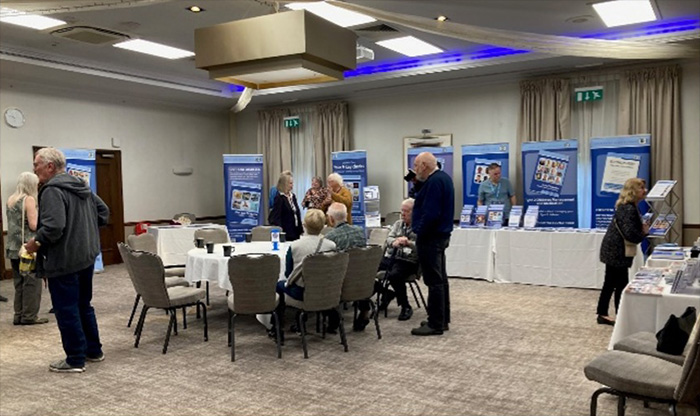
Jenny Hirst, co-chair, welcomed everyone and reminded us that we have been getting together since 1994 when the Trust was formed to fight for continuing availability of animal insulin – which we still have, thanks to lobbying. The Trust’s focus remains supporting anyone living with diabetes and one way in which it does this is by annually sending out 135,000 printed leaflets to healthcare professionals to pass to patients. This is an annual cost of around £70,000 which needs to be kept under review. The Trust also continues to collect donated diabetes supplies and knitted treats to send to Ukraine.
The meeting went through the formal business of apologies for absence, approval of the annual accounts with overall decreased income but next year’s accounts will show the eventual receipt, after 20 years, of a sizeable legacy. Fundraising has doubled and costs were lower last year as the massive advertising campaign was wound down. The existing trustees and nominated new trustees, Karen Merrey and Mabel Blades, were voted in. The floor congratulated the Trust on achieving so much with so few dedicated staff, and Jenny affirmed that the key is good teamwork and staff being happy to be adaptable and take on new challenges.
Tamsin Fletcher-Salt, Diabetes and Endocrinology Nurse Clinical Lead (and living with Type 1 diabetes)
This talk covered the new technology available to help those living with T1D. Not only are HbA1cs being lowered, but the mental health burden of living with diabetes can be relieved. CGMs and hybrid closed loop system availability should no longer be a postcode lottery for those with Type 1, but there can be delays in access while waiting for Health Professionals to be trained. CGMs have been approved for a subset of those with Type 2, NICE issues guidance, not mandates, so some Integrated Care Boards (ICBs) may be choosing not to approve requests.
There was a warning that some of the continuous glucose monitors advertised on social media may not have gone through strict testing in clinical trials and may be inaccurate especially in those without diabetes.
Future treatments offering hope were discussed
Dr Rebecca Thomas
The talk focussed on diabetic retinopathy explaining that high blood glucose damages the smallest blood vessels in the body and evidence is found first in the eyes, hence screening to look for the earliest signs of retinopathy. Retinopathy is also a marker for risk to other vessels if HbA1c does not improve. If found there will be a drive to improve HbA1c and lipid profiles, optimise blood pressure and prevent further deterioration.
We can also help our eyes by spending 20 seconds focussing long distance for every 20 mins looking at a screen and by blinking or using drops to increase eye moisture. We should wear sunglasses and wide-brimmed hats in the sun to avoid UV damage to the eyes. Regular optician appointments are also recommended to check for glaucoma and cataracts. Diets rich in healthy greens, citrus fruit, nuts and oily fish also help eye health.
Retinopathy does not mean inevitable sight loss – after 20 years of diabetes retinopathy only occurs in 30% of T1D and 20% T2D. We were encouraged to always attend our screening and have dilating drops so the best pictures are obtained. If screening shows no background retinopathy, screening will drop to every two years, otherwise annually, or even more frequently if signs of deterioration. Treatments are available – laser treatment, injections.
Diabetic maculopathy (different from macular degeneration) can also occur and will be picked up at retinal screening with a referral to ophthalmology for additional screening and a treatment programme.
CGM and Hybrid Closed Loop pumps which improve HbA1c should reduce diabetic eye complications, but reductions in HbA1c should start slowly and steadily to reduce the risk of altered retinal blood flow progressing.
Gemma Andrews
Most of us have foot pulses and microfilament testing at our general practice annual reviews. It’s also possible to purchase a neuropad from IDDT to test our feet for neuropathy. The main cause of neuropathy is damage to the myelin sheath (insulating cover) of the nerves due to vascular reduction. Good self-screening and early reporting of problems is important as there is a major shortage of NHS podiatry services across the UK, especially those specialising in foot issues in diabetes.
However, some good news – a new professional group Footcare Health Practitioners are being trained and rolled out.
If you see someone about your feet, report how long you’ve had diabetes, your HbA1c, your medications, any other health issues and then move onto your feet – have you ever had ulcers? Dry cracked skin? Excessive heat or sweating of the feet? A change in gait (has the wear pattern on the bottom of your shoes changed? Are you loosing your balance? Numbness? Burning or tingling? Sharp shooting pains especially at night? Cramping? Restless legs? All of these can indicate vascular reduction to the feet and/or diabetic neuropathy. Don’t be put off – you need to get seen! IDDT has a foot health leaflet.
Charcot foot – this often occurs after foot trauma. Pre-existing neuropathy alters blood flow and leads to an abnormal trauma response – get bumpy veins, pale foot but warm to the touch, a temperature difference between the feet, the arch of the foot decreases and then pressure increases under certain bones leading to callus building up which can ulcerate.
Changes in gait can occur with vascular reduction and neuropathy – calf muscles waste, get a floppy foot gait, prone to calluses and ulceration, hard to maintain balance, struggle to walk backwards.
Full clinical assessment of feet in diabetes will be feeling pulses in multiple locations but also using a doppler to “hear” vascular waveforms, vibration assessment, response to pain, full vascular assessment including observing skin tone, nails, hair loss, cold or hot, whether an area returns to pink after pressure, and an assessment of blood pressure in the foot.
A thoroughly delicious lunch followed the morning talks, with time afterwards for chatting with others living with diabetes, browsing the IDDT stalls and speaking to the FreeStyle Libre representative.
Various topics were discussed which covered more on CGMs (John Pemberton’s podcast recommended) – only use a thoroughly tested monitor or your meal boluses will be inaccurate. Finger pricking still gold standard – if you doubt your CGM then finger prick but remember there is a delay of at least 10 mins on CGM if your blood glucose is rising or falling rapidly.
There was more on Mounjaro jabs – some people with Type 1 only need background insulin not meal jabs when taking it but there are risks of hypos. There was also a discussion on the variety of hypo symptoms, difficulties for partners treating a severe hypo especially if the hypo is causing resistance or aggression. Finally, the “best” hybrid closed loop systems were discussed with lots of factors in choosing a pump – look at the Diabetes Technology Network Videos or download the DSN Forum comparison chart. Ypsomed and Medtronic have the most responsive and accurate algorithms.
Dr Seidu explained the screening programme looking for risks of Type 2 diabetes in those over 40 which is part of an adult health check. If blood glucose is high and especially if the blood pressure is high, the GP systems “code” the entry and a patient will be referred to the National Diabetes Prevention programme. We were reminded we can now look at our own records using the NHS App. You will be called back more than annually if not getting good control of blood glucose, lipids or blood pressure. Some people with T2D are getting remission on 800 cal per day diets but this doesn’t suit everyone. As well as prescribing there is lifestyle advice and increasingly GP staff are sending “leaflets” by text or email, links to short videos via smartphones eg on injection technique etc. Don’t forget IDDT still has tried-and-tested written leaflets for you – and a helpline!
Dr Seidu covered T2D drugs – metformin which can have gastro side effects or lead to reduced kidney functioning or B12 deficiency occasionally but is generally well-tolerated. Gliclazide is the next step but can cause hypos. A range of other medications are available. As Type 2 progresses insulin may become necessary, with monitoring by finger pricking especially in those who drive or use machinery – CGM may be available for some. In older patients it may be best to reduce diabetic control to reduce the risk of life-altering side effects eg being awoken at night by need to pee.
In Type 1 treatment with insulin is usually initiated in specialist care with annual checks in primary care and if everything stable care may be transferred entirely to primary care.
When someone is called back to discuss risks for diabetes, or when someone with existing diabetes is screened for other complications, it’s also an opportunity for the patient to raise other issues with the healthcare professional – eg Dr Seidu’s practice has found about domestic abuse at one of these “routine” checks.
There was a comment about the patient-problem of being told “one appointment, one problem”. Dr Seidu suggested saying “My problem is diabetes related” – this is true – if you have had diabetes for a long time, it is almost inevitable you will have co-existing problems – that way you can raise multiple issues.
Finally, a comment from the floor led us to hear about a positive use of AI in some general practices – with the patient’s permission AI can be switched on in the background to listen in to a GP consultation. The AI will write up the session notes, generate information for the patient, and write letters if needed eg referral (all checked by the GP). This means the GP can spend the entire 10 minutes listening to the patient instead of only 2 with the patient and 8 doing admin!
Thanks were given to the staff for providing so much information, support, direction and assistance during the day.